


In the realm of industrial ventilation, selecting the appropriate fan type is paramount for optimizing performance, energy efficiency, and operational costs. Two primary categories dominate the landscape: centrifugal fans and axial fans. While both are designed to move air, their operational principles, design characteristics, and ideal applications differ significantly.
This comprehensive guide aims to demystify these differences, providing a clear comparison to help businesses make informed decisions for their specific industrial needs. Understanding the nuances between these fan types is crucial for ensuring effective air movement, whether for cooling, ventilation, or material transport.
Key Takeaways
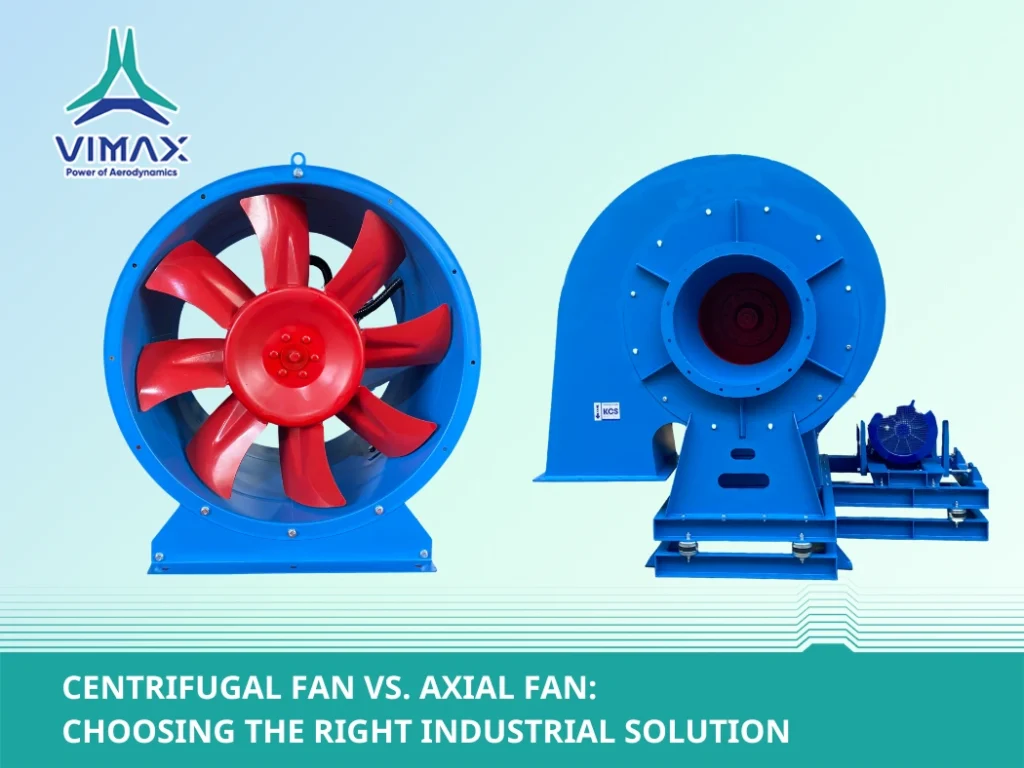
- Axial fans: straight airflow (parallel to axis), high volume – low pressure, energy-efficient, compact but noisier
- Centrifugal fans: 90° airflow (radial), high pressure – lower volume, stable in high-resistance systems, quieter but larger
- Axial: best for simple ventilation and open spaces
- Centrifugal: best for ductwork, dust collection, and harsh environments
- Vimax Global: cost-optimized, high-quality solutions tailored to industrial conditions
Understanding Axial Fans
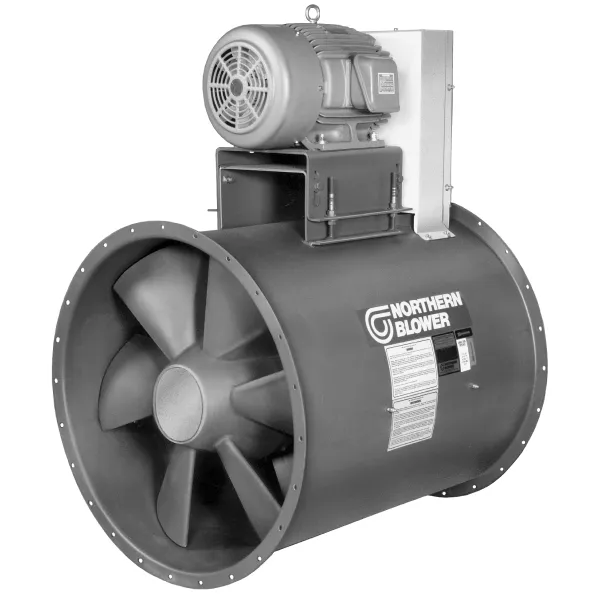
Axial fans operate on a principle similar to an airplane propeller, where air flows parallel to the fan’s axis. This design allows for direct and efficient air movement in a straight line.
Design & Characteristics
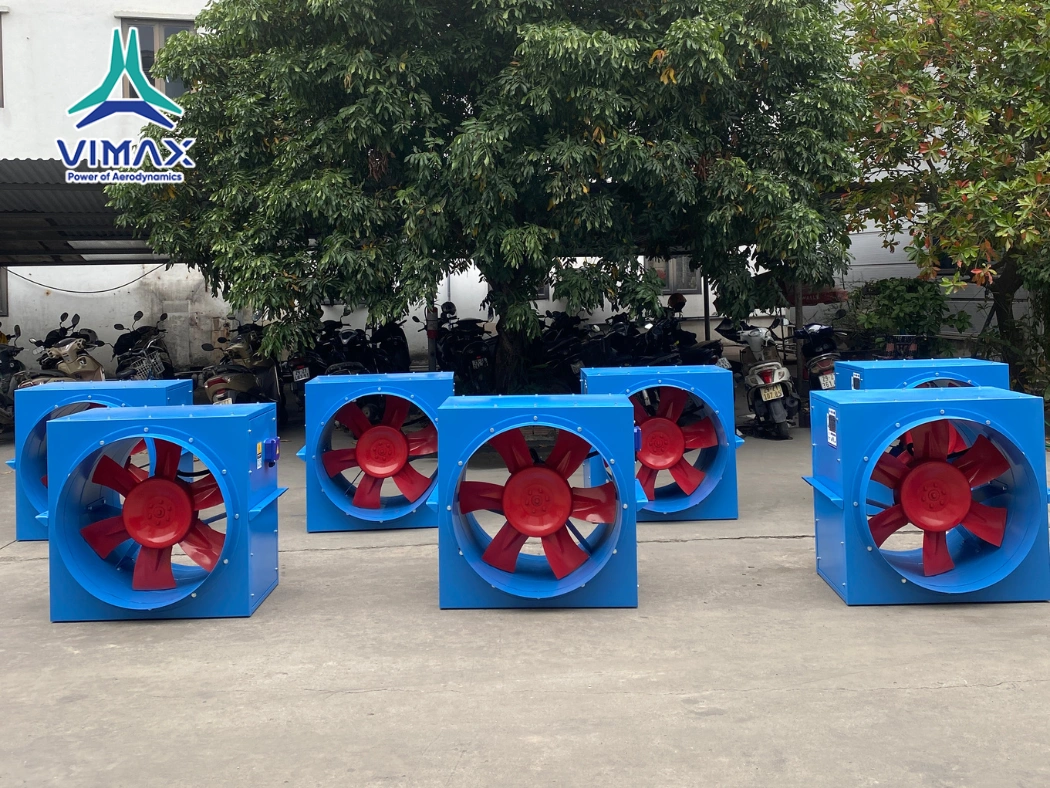
Axial fans typically feature propeller-like blades mounted on a central hub. They are characterized by their ability to move large volumes of air at relatively low pressures. Their design is often compact, making them suitable for installations where space is a constraint.
Advantages
- High Airflow Volume: Excellent for applications requiring the movement of large quantities of air.
- Compact Design: Their inline configuration often requires less space, simplifying installation in tight areas.
- Cost-Effective for Simple Ventilation: Generally more economical in terms of initial purchase and installation for straightforward air movement tasks.
Disadvantages
- Low Static Pressure Capability: Less effective at moving air against significant resistance, such as through extensive ductwork or filters.
- Can Be Noisier: Due to their high-speed operation and direct air movement, axial fans can generate more noise compared to centrifugal fans for similar airflow rates
- Less Efficient Against High System Resistance: Performance degrades rapidly when faced with high static pressure requirements.
Typical Applications
Axial fans are widely used in applications such as general ventilation, cooling electronic enclosures, exhaust systems, comfort cooling in commercial spaces, HVAC systems, and condenser cooling in refrigeration units.
Read more: Choosing the Best Axial Fans Supplier for Your Industrial Needs
Understanding Centrifugal Fans
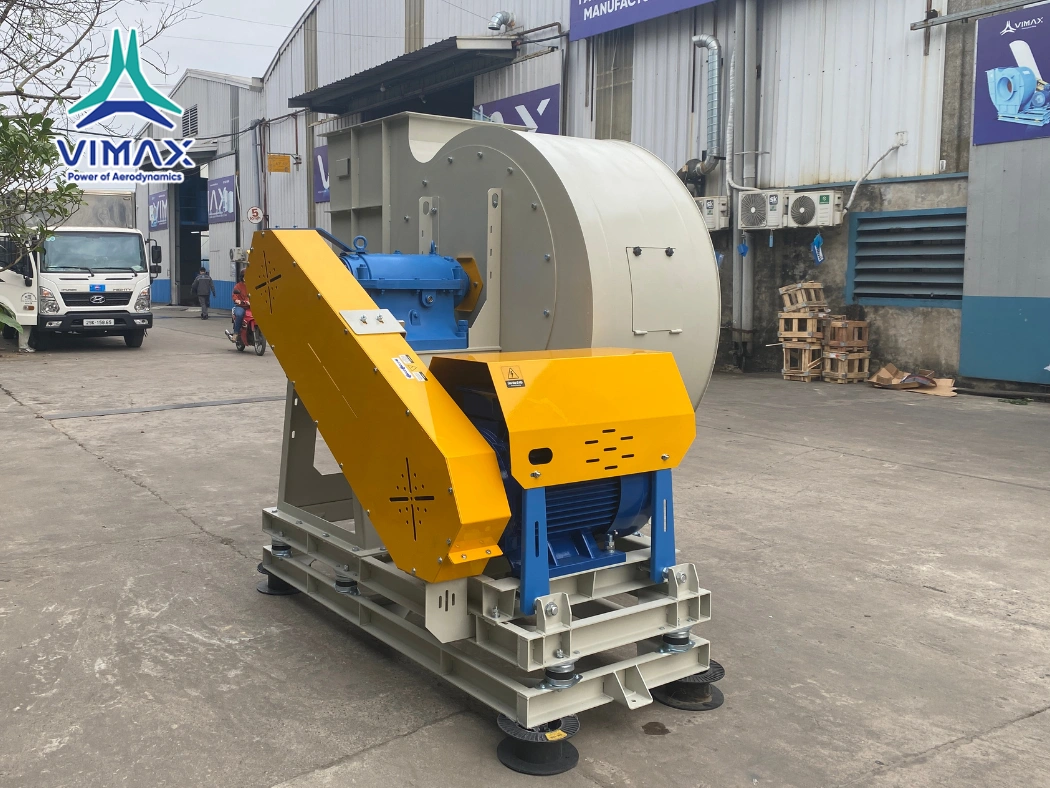
Centrifugal fans, often referred to as blowers, operate by drawing air into the fan inlet axially and then expelling it radially (at a 90-degree angle) from the fan outlet. This change in direction is achieved by an impeller that spins within a scroll-shaped housing.
Design & Characteristics
Centrifugal fans utilize an impeller with blades that can be forward-curved, backward-curved, or radial. This design allows them to generate high static pressure, making them ideal for applications that involve moving air through ductwork, filters, or other components that create resistance. They typically move lower volumes of air compared to axial fans of similar size but excel in overcoming system pressure drops.
Advantages
- High Static Pressure Capability: Exceptionally effective at moving air against high resistance, making them perfect for ducted systems, air handling units, and industrial processes.
- Quieter Operation: For comparable performance in high-pressure applications, centrifugal fans are generally quieter than axial fans.
- More Efficient in High-Resistance Systems: Their design allows them to maintain efficiency even when system resistance varies.
- Can Handle Contaminated Air Streams: Certain blade designs (e.g., radial blades) are well-suited for handling air with dust, particles, or corrosive elements.
Disadvantages
- Lower Airflow Volume: Typically move less air volume than axial fans of a similar physical size.
- Larger Footprint and Heavier: Their design often requires more space and results in a heavier unit, which can impact installation and cost.
- Generally More Expensive: Higher manufacturing complexity and material requirements often lead to a higher initial cost.
Typical Applications
Centrifugal fans are indispensable in industrial processes such as material conveying, drying systems, HVAC systems (especially in air handling units), fume extraction, dust collection, and targeted cooling in manufacturing environments.
Read more: Is Industrial Fan High in Electricity Consumption? Understanding the Energy Draw
Centrifugal vs. Axial Fans: A Direct Comparison
To further clarify the distinctions, the table below provides a direct comparison of key features:
| Feature | Axial Fans | Centrifugal Fans |
| Airflow Direction | Parallel to fan axis | Perpendicular (90°) to intake |
| Pressure | Low static pressure | High static pressure |
| Air Volume | High | Lower |
| Efficiency | Good for low resistance | Good for high resistance |
| Noise Level | Can be noisy | Generally quieter |
| Size/Footprint | Compact | Larger |
| Cost | Generally lower | Generally higher |
| Blade Design | Propeller-like | Impeller with various blade types (forward, backward, radial) |
| Best Use Case | Moving large volumes of air against low resistance | Moving air against high resistance (e.g., ductwork) |
Choosing the Right Fan for Your Application
Selecting between a centrifugal and an axial fan requires a careful evaluation of your specific operational needs. Making the right choice ensures optimal performance and cost-effectiveness.
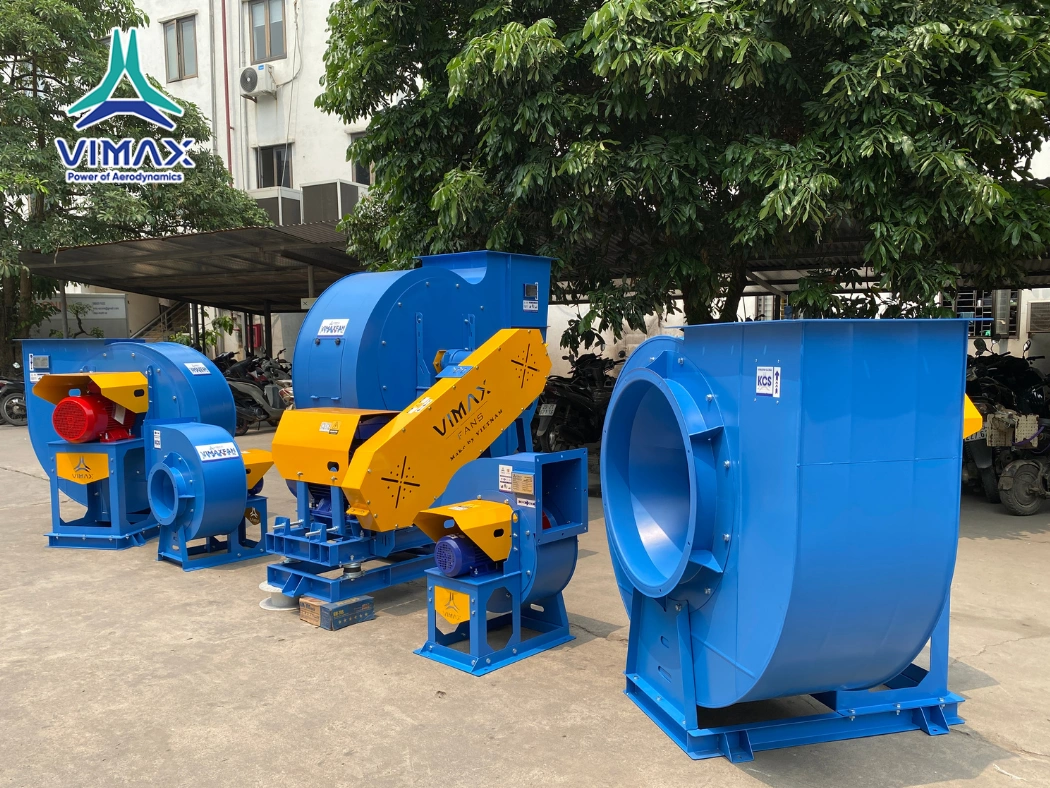
Key Considerations
- Application Requirements: Clearly define the primary function. Is it general ventilation, material transport, fume extraction, or targeted cooling?
- Pressure vs. Volume: Determine whether your application demands high airflow (typically axial) or high pressure to overcome system resistance (typically centrifugal).
- Space Constraints: Evaluate the available space for fan installation. Axial fans are often more suitable for compact areas.
- Noise Levels: Consider environmental noise regulations and the comfort requirements of the operating area.
- Operating Environment: Assess factors like temperature, the presence of dust, corrosive elements, or explosive gases, as these can influence material selection and fan design.
- Energy Efficiency & Cost: Analyze both the initial investment and the long-term operating costs, including energy consumption and maintenance.
- When to choose Axial Fans: Opt for axial fans when your primary need is to move large volumes of air against low system resistance, such as in general room ventilation, exhaust systems, or direct cooling applications where air needs to be moved across a short distance.
- When to choose Centrifugal Fans: Choose centrifugal fans for applications requiring high static pressure to push air through extensive ductwork, filters, or other components that create significant resistance. They are also preferred for industrial processes involving material handling, fume extraction, or dust collection.
VIMAX GLOBAL: Your Partner for Optimal Industrial Fan Solutions
Making the correct fan selection can be complex, given the wide range of options and specific application requirements. That’s where our expertise comes in.
At VIMAX GLOBAL, we position ourselves as a trusted provider of industrial fan solutions, committed to delivering high-quality yet cost-effective products tailored to diverse industrial needs. As a Vietnamese brand, we take pride in combining local expertise with international standards, offering a comprehensive range of both centrifugal and axial fans.
With deep knowledge of fan technologies and their applications, we ensure that every solution we provide is efficient, durable, and optimized for both budget and operational performance. Whether you need a robust centrifugal fan for a demanding dust collection system or an energy-efficient axial fan for general ventilation, we are ready to support you with reliable products and technical expertise to meet your challenges.
