


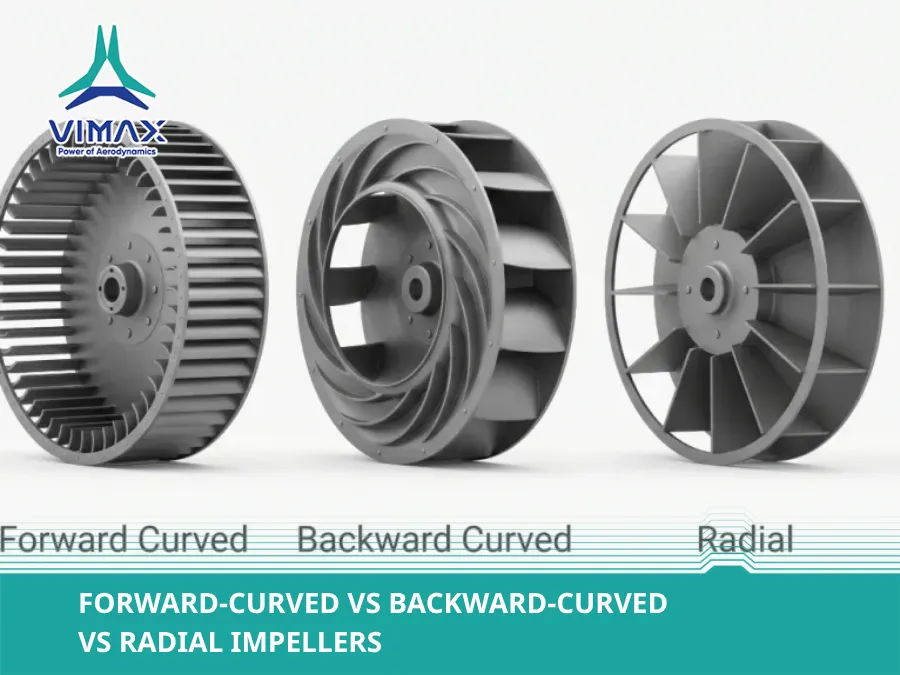
Two centrifugal fans can share the same housing, the same motor and the same duty point, yet behave completely differently once they are installed. The reason is usually the impeller. The shape of the blades decides how efficiently the fan converts motor power into pressure, whether the motor can overload, how loud the fan runs, and how long it survives in dusty or sticky air.
This guide compares the three basic centrifugal blade families — forward-curved, backward-curved (including backward-inclined and airfoil) and radial — and shows engineers and buyers how to match each one to the air stream, the system and the budget.
Key Takeaways
- Forward-curved (FC): many small blades, low speed, compact and quiet. Best for clean air at low pressure, such as HVAC air handling units. Power keeps rising with airflow, so the motor can overload.
- Backward-curved / backward-inclined (BC/BI): 8–12 larger blades, highest efficiency (about 82% for flat blades, up to about 90% for airfoil designs). Non-overloading power curve. Best for clean or lightly dusty industrial air.
- Radial: straight, rugged, self-cleaning blades. Lowest efficiency but the best choice for heavy dust, sticky material and pneumatic conveying at medium to high pressure.
- Radial tip: a hybrid between radial and backward-inclined — higher efficiency than straight radial, still tolerant of contaminated air.
- Rule of thumb: clean air and energy cost first → backward-curved; heavy or abrasive particulate → radial; tight space and low pressure → forward-curved.
How Blade Shape Changes Fan Performance
In every centrifugal fan, air enters the impeller axially, is accelerated by the blades and leaves radially into the scroll housing. What differs between impeller types is the angle at which each blade leaves the wheel, measured against the direction of rotation:
- Forward-curved: the blade tip leans into the direction of rotation. It throws air off the wheel at a very high tangential velocity.
- Radial: the blade runs straight out from the hub, at 90° to the direction of rotation.
- Backward-curved / backward-inclined: the blade tip leans away from the direction of rotation, so the air leaves the wheel more slowly but with more of its energy already converted into static pressure.
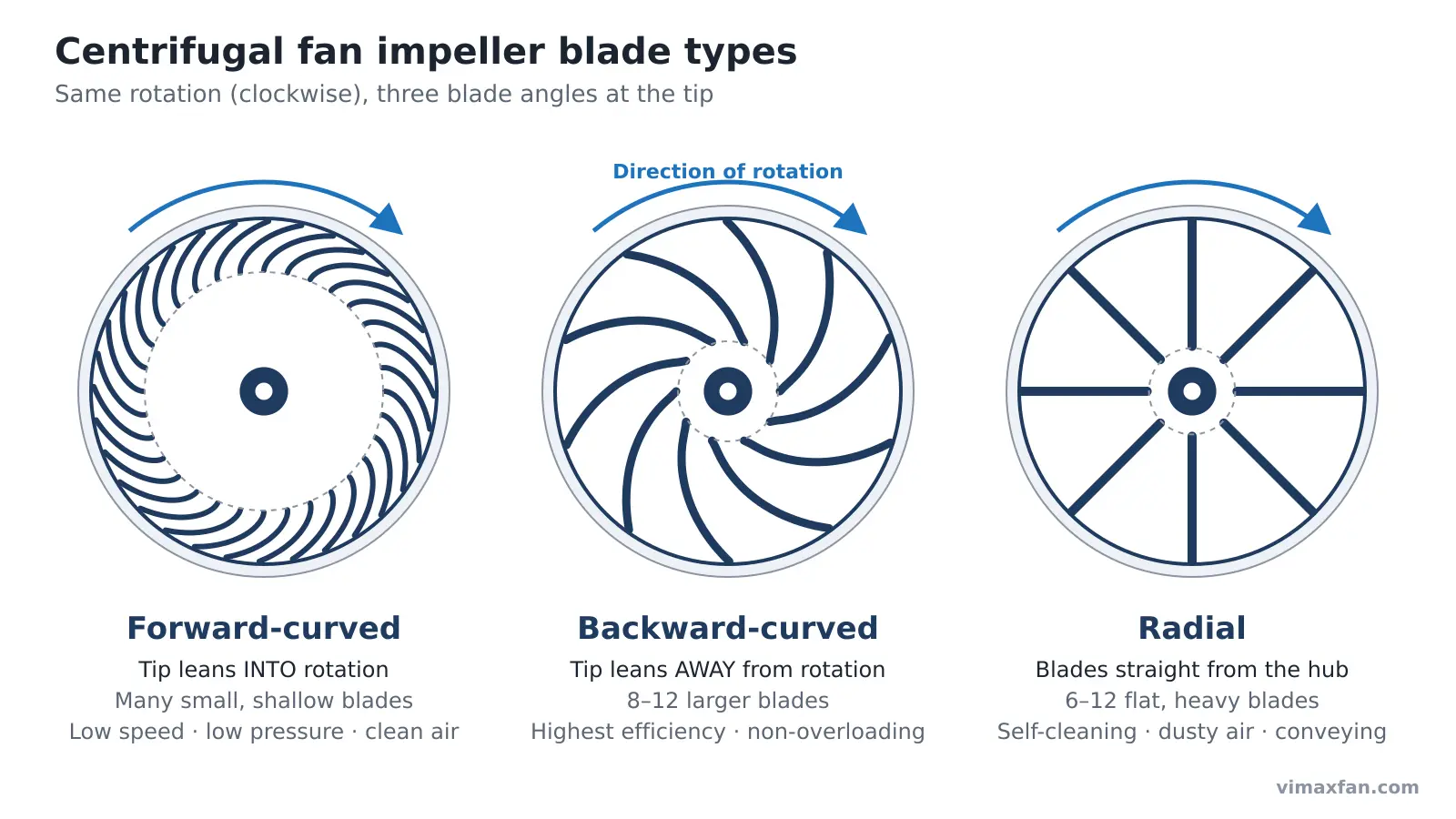
This single geometric difference drives everything else. Because a forward-curved wheel puts so much energy into air velocity, it reaches a given pressure at the lowest speed of the three; a backward-inclined wheel needs the highest speed, and a radial wheel sits in between. A forward-curved wheel also depends heavily on its housing to convert velocity into pressure, which is why it performs poorly as a plug or plenum fan, while a backward-inclined wheel can run without a scroll at all.
Speed, in turn, sets the construction. Low-speed forward-curved fans can be built light and cheap. High-speed backward-inclined fans need heavier construction and precision balancing. Radial fans are built heavy for a different reason: to survive dust, abrasion and shock loads.
Forward-Curved (FC) Impellers
Forward-curved wheels — also called “squirrel cage”, “sirocco” or “volume” blowers — use many small, shallow blades with a pronounced curve, the concave side facing the direction of rotation. They move high airflow at low static pressure, typically up to about 6 in. wg (≈1,500 Pa), with most applications at 3 in. wg (≈750 Pa) or less.
Advantages
- Lowest speed for a given duty, so the fan runs quietly.
- Light construction and small size: low first cost and a compact footprint.
- High airflow from a small wheel diameter.
Limitations
- Overloading power curve: brake power keeps rising as airflow increases. If the system resistance turns out lower than designed — an open access door, a missing filter, oversized ductwork — the motor can trip or burn out.
- Stall region: the pressure curve has a pronounced dip. Selections left of roughly 40–45% of free delivery give pulsating, unstable airflow that can damage the impeller.
- Poor dust tolerance: the many narrow blade passages clog quickly with dust or grease.
- Static efficiency is moderate, and the light construction rules out most heavy-industry duties.
Typical applications: air handling units, fan coil units, furnaces, packaged HVAC equipment, clean-air supply and low-pressure ventilation.
Backward-Curved and Backward-Inclined (BC/BI) Impellers
Backward wheels use fewer, larger blades — usually 8 to 12 — inclined away from the direction of rotation. The family comes in three standard blade shapes:
- Flat single-thickness (backward-inclined, BI): simple and robust; about 82% peak efficiency.
- Curved single-thickness (backward-curved, BC): about 86% peak efficiency.
- Airfoil (BIA): hollow, wing-shaped blades; up to about 90% peak efficiency.
Backward-inclined fans typically deliver medium to high airflow at static pressures up to about 20 in. wg (≈5 kPa), and up to about 40 in. wg (≈10 kPa) with special construction.
Advantages
- Highest efficiency of all centrifugal types, which means the lowest energy cost over the fan’s life.
- Non-overloading power curve: brake power rises to a peak and then falls toward free delivery. A motor sized for that peak will not overload, even if system resistance changes, as long as speed stays constant.
- Stable over a wide operating range; quieter than radial fans at comparable duty.
- Can run without a housing, so it suits plug, plenum and in-line fans.
Limitations
- Highest operating speed, which requires heavier construction and precision balancing. First cost is higher than for forward-curved fans.
- Close running clearances make it unsuitable for bulk material handling.
- Airfoil blades are hollow: abrasive dust can erode them and moisture can collect inside, so airfoil wheels are for clean air only. Flat or curved single-thickness blades tolerate light dust and corrosive air.
Typical applications: general industrial ventilation and exhaust, the clean side of dust collectors and filters, furnace and boiler draft, large commercial HVAC units, cleanrooms and process air.
Radial Blade Impellers
Radial wheels — “paddle wheel” or “steel plate” fans — use six to twelve flat, deep, heavy blades running straight out from the hub. The design leaves few ledges where dust or sticky material can build up, so the blades are largely self-cleaning.
The main variants are:
- Open paddle wheel: no backplate; the most rugged option for material conveying.
- Backplate wheel: blades welded to a backplate; the most common radial design.
- Radial tip: blades curve near the hub and run radially at the tip. Efficiency is higher than straight radial and the wheel still tolerates contaminated air. It is not intended for bulk material.
Advantages
- Handles heavy, abrasive or sticky particulate and conveys material through the fan.
- Simple, rugged construction; blades are easy to replace or hard-face against wear.
- Suited to medium-to-high pressure at low-to-medium airflow; a straight radial wheel can run stably down to about 20% of free delivery.
Limitations
- Lowest efficiency of the three families, so energy cost is higher.
- Overloading power curve, like the forward-curved fan.
- Noisier and physically larger for the same airflow.
Typical applications: pneumatic conveying, wood chips and sawdust, cement and mineral dust, dust collection where the fan sits on the dirty side, combustion air and high-pressure process air. Because of the shock loads and harsh environments, radial fans are usually belt-driven.
Side-by-Side Comparison
The table summarises typical characteristics. Actual figures depend on wheel design, housing and size, so always check the manufacturer’s tested fan curve (AMCA 210 / ISO 5801) for the specific model.
| Characteristic | Forward-Curved | Backward-Curved / Inclined | Radial |
| Blade count | Many (often 24–64), small and shallow | 8–12, larger | 6–12, flat and deep |
| Speed for a given pressure | Lowest | Highest | Medium |
| Pressure range | Low (mostly ≤ 3 in. wg / 750 Pa) | Medium to high (up to ~20 in. wg / 5 kPa) | Medium to high |
| Airflow | High volume, compact wheel | Medium to high | Low to medium |
| Typical peak efficiency | ≈ 55–65% | ≈ 82% flat · 86% curved · 90% airfoil | ≈ 45–60% (radial tip higher) |
| Power curve | Overloading | Non-overloading | Overloading |
| Stable operating range | Narrow; stall dip left of peak | Wide; select right of peak | Wide; stable down to ~20% of free delivery |
| Dust / sticky material | Poor — clogs | Light dust only (not airfoil) | Excellent — self-cleaning |
| Noise | Low | Low to moderate | High |
| Construction and cost | Light, lowest cost | Heavy, precision balanced, higher cost | Rugged, heavy |
| Typical use | HVAC, AHUs, clean supply air | Industrial ventilation, clean-side exhaust, boiler draft | Conveying, heavy dust, high-pressure process air |
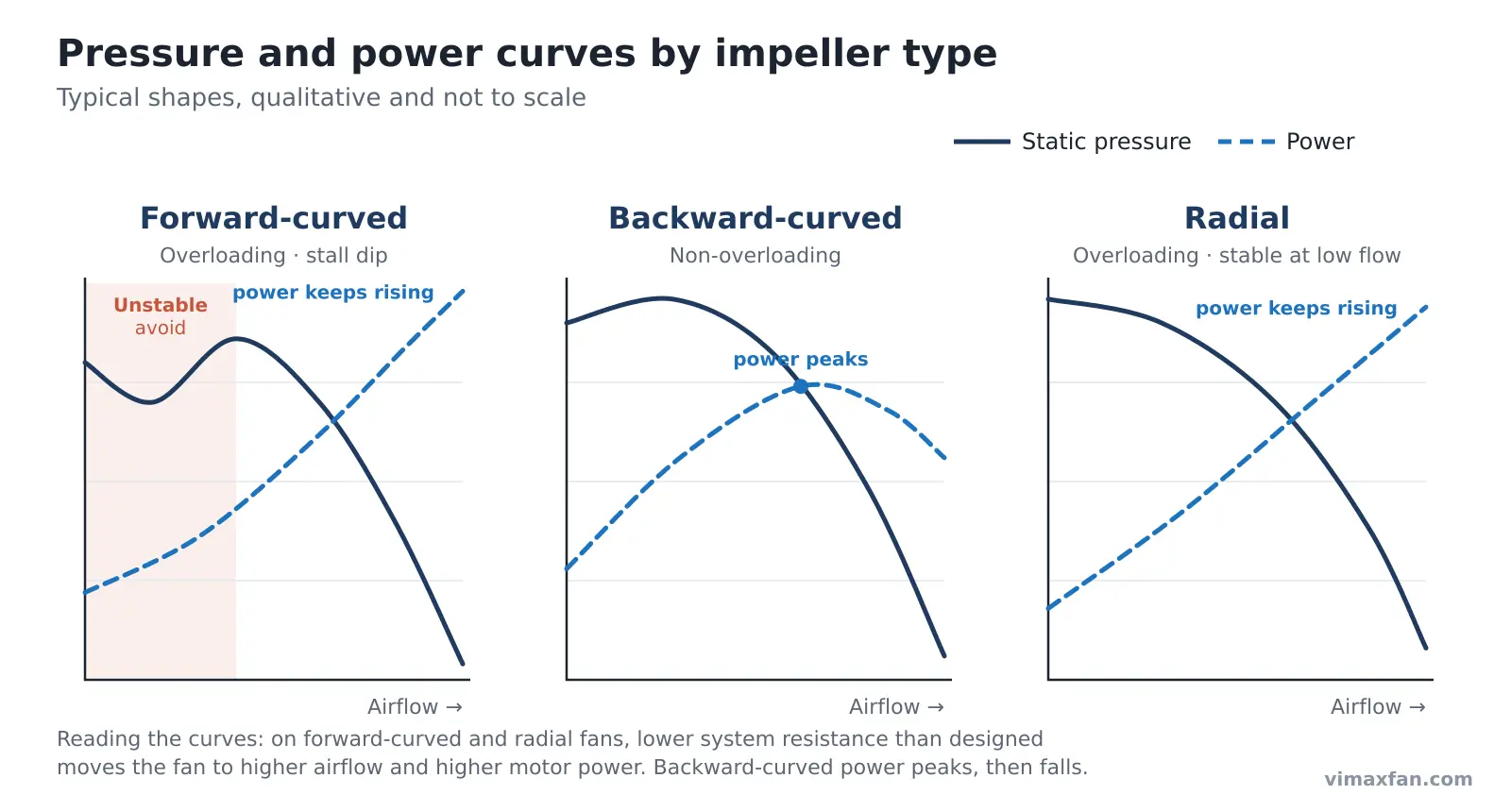
The power curves are the most important line in the comparison. With a forward-curved or radial fan, a system that turns out to have less resistance than designed pushes the fan to higher airflow and higher power — the motor must be sized for the worst case. A backward-curved fan’s power peaks near its best-efficiency point and then falls, which protects the motor when the real system differs from the drawings.
How to Choose the Right Impeller
Start with the air stream, not the efficiency figure. A high-efficiency airfoil wheel that erodes in six months costs far more than a radial wheel that runs for ten years.
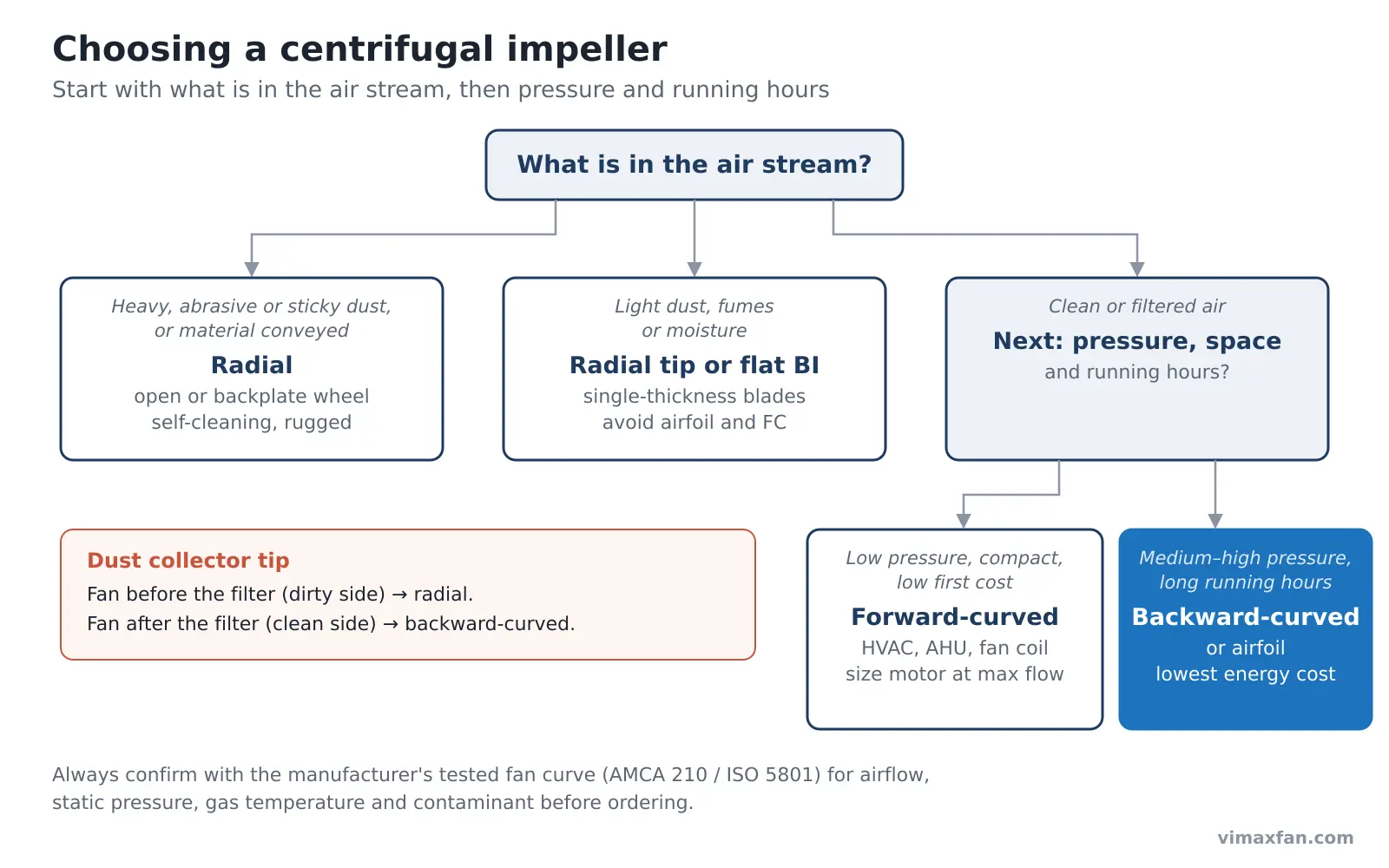
Work through these five questions in order:
- What is in the air? Heavy, abrasive, fibrous or sticky material, or material conveyed through the fan → radial (open or backplate). Light dust, fumes or moisture → radial tip or single-thickness backward-inclined. Clean or filtered air → any type.
- How much pressure does the system need? Low pressure (roughly under 750 Pa) with high airflow in a tight space favours forward-curved. Medium to high pressure favours backward-curved or radial.
- How stable is the system resistance? If filters load up, dampers move or the as-built ductwork may differ from design, a non-overloading backward-curved wheel protects the motor.
- How many hours per year will it run? For fans running two or three shifts a day, the efficiency gap between impeller types usually outweighs the difference in purchase price. Backward-curved or airfoil wheels pay back fastest, especially with a variable-frequency drive.
- What are the space, noise and temperature limits? Forward-curved is the most compact and quietest at low pressure. High-temperature duty needs suitable materials and a cooling wheel or shaft seal whatever the blade type — see our guide to heat- and corrosion-resistant fans.
Common selection mistakes
- Putting an airfoil or forward-curved fan on the dirty side of a dust collector. Place it on the clean side, after the filter, or use a radial wheel before the filter.
- Sizing a forward-curved or radial fan’s motor at the design point only. Check power at the highest airflow the system can reach.
- Selecting any fan left of the pressure peak, where airflow becomes unstable.
- Comparing quotes on fan price alone instead of fan price plus lifetime energy cost.
If a fan is already installed and underperforming, the cause is often the system rather than the impeller. See how to fix a centrifugal fan that spins but does not extract dust, and for the broader choice between fan families read Centrifugal Fan vs. Axial Fan.
Custom and OEM Centrifugal Fans from VIMAX GLOBAL
VIMAX GLOBAL designs and manufactures industrial centrifugal fans in Vietnam, in low, medium and high-pressure ranges, direct- or belt-driven. Our engineers use CFD simulation and FEM analysis to match the impeller to your air stream, then verify performance in our in-house testing area before shipment.
For OEM and export buyers we supply fan curves, test reports, manuals and private-label branding with each order. Send us your airflow, pressure, gas temperature and contaminant details, and we will recommend the impeller type and model.
Request a fan selection and quote →
Frequently Asked Questions
Which centrifugal fan blade type is the most efficient?
Backward-curved airfoil impellers are the most efficient, reaching about 90% peak efficiency. Curved single-thickness blades reach about 86% and flat backward-inclined blades about 82%.
What does “non-overloading” mean for a fan?
It means the fan’s brake power reaches a maximum and then falls as airflow increases. A motor sized for that maximum cannot be overloaded by changes in system resistance at constant speed. Backward-curved and backward-inclined fans are non-overloading; forward-curved and radial fans are not.
Which impeller is best for dusty air?
Radial blade impellers are best for heavy, abrasive or sticky dust and for conveying material, because their straight blades are self-cleaning and rugged. Radial tip and single-thickness backward-inclined wheels can handle light dust. Avoid forward-curved and airfoil wheels in dirty air.
Why are forward-curved fans used in HVAC equipment?
They deliver high airflow at low pressure from a small, low-speed wheel. That makes them compact, quiet and inexpensive — ideal for air handling units, fan coils and furnaces moving clean air.
Is a backward-curved fan the same as a backward-inclined fan?
They belong to the same family. Backward-inclined usually means flat single-thickness blades; backward-curved means curved single-thickness blades; airfoil blades are a hollow, wing-shaped version. All three share a non-overloading power curve, with efficiency rising from flat to airfoil.
Can I replace a forward-curved wheel with a backward-curved wheel in the same housing?
Usually not directly. The two wheels run at very different speeds for the same duty and are designed for different housings and drives. A retrofit normally means a new fan selection, including motor, drive and possibly the housing — ask the manufacturer to check the full system.
