Industrial fans and blowers rarely get attention until one of them fails. Yet they keep dust out of the breathing zone, pull heat away from furnaces and data halls, feed combustion air to boilers, exhaust smoke in an emergency, and carry material through pneumatic conveying lines. Choosing the right supplier affects uptime, energy bills, safety compliance and maintenance workload for many years.
The United States has one of the deepest fan and blower industries in the world, with companies that have been building air-moving equipment for 70 to more than 150 years. This guide profiles eight leading names, explains how they differ, and gives you a practical framework (specifications, standards, regulation, total cost of ownership and an RFQ checklist) for turning a shortlist into a purchase.
How to read this guide. The companies below are listed as an editorial overview, not a paid or scored ranking. Company facts come from public sources (company websites, catalogs, press releases and trade directories) as of October 2026. Product ranges, ownership and plant footprints change, so confirm details directly with each supplier before you specify equipment.
Key Takeaways
- The US market is mature and consolidating. Several well-known brands now sit inside larger groups, so always check who actually owns and supports the product line you are buying.
- Suppliers differ mainly in three ways: breadth (Greenheck, Twin City Fan), heavy-duty process engineering (Howden, New York Blower, Chicago Blower) and OEM or application focus (Cincinnati Fan, Acme, Loren Cook).
- Performance claims only mean something if they are backed by recognized testing. Look for AMCA-licensed ratings and an in-house or accredited air and sound laboratory.
- Energy is usually the largest lifetime cost of a continuously running fan, and federal efficiency rules based on the Fan Energy Index (FEI) are moving toward mandatory status.
- If you are sourcing for an export project or want an additional bid, qualified overseas manufacturers such as VIMAX (Vietnam) are worth including in the comparison.
Quick Comparison
| Company | Headquarters | Roots | Best known for | Typical fit |
| Twin City Fan Companies (Twin City Fan & Blower, Aerovent, Clarage) | Minneapolis, MN | Group heritage since 1874 | Broad engineered range, custom designs, multiple brands | Industrial, commercial, power, ag, transportation |
| Greenheck | Schofield, WI | 1947 | Widest catalog of air movement and control products | Commercial and industrial HVAC, kitchen, make-up air |
| Howden | Glasgow, Scotland (major US operations) | 1854 | Heavy-duty process, power and mining fans | Utilities, cement, steel, mining, nuclear, tunnels |
| Chicago Blower | Glendale Heights, IL | 1947 | Pre-engineered and custom heavy-duty fans | Process, ovens, food, mining, OEM |
| Cincinnati Fan | Mason, OH | 1956 | OEM blowers and fast-turn built-to-order fans | OEM equipment, critical exhaust, light industrial |
| New York Blower | Chicago area / La Porte, IN | 1889 | Custom fans, large AMCA-accredited lab | Heavy industrial, retrofit, OEM |
| Loren Cook Company | Springfield, MO | 1941 | Commercial ventilation and kitchen exhaust | Commercial and institutional, light industrial |
| Acme Engineering & Manufacturing | Muskogee, OK | 1938 | Commercial, ag, horticultural and OEM fans | Commercial, agricultural, OEM |
How We Looked at Each Manufacturer
A useful shortlist is based on more than brand recognition. For each company we considered:
- Heritage and stability: years in business, ownership and manufacturing footprint.
- Product breadth: centrifugal, axial, mixed-flow, pressure blowers, roof exhausters and specialty designs.
- Engineering and testing: air and sound laboratories, AMCA participation, and the ability to build custom equipment.
- Aftermarket support: spare parts, field service, retrofits and rebuild programs.
- Market focus: whether the company concentrates on heavy industry, OEMs or commercial buildings.
1. Twin City Fan Companies (Twin City Fan & Blower, Aerovent, Clarage)

Minneapolis, Minnesota · About 1,500 employees
Twin City Fan Companies, Ltd. is a privately held group whose business units include Twin City Fan, Aerovent and Clarage. The company says it has been creating better indoor environments since 1874 and serves industrial, commercial, agricultural, institutional, municipal and transportation customers. One thing buyers often miss: Aerovent is a Twin City Fan Companies business, so you should treat the two names as one corporate family when comparing quotes.
What stands out
- Range: centrifugal, axial and mixed-flow fans, including designs for applications such as kitchen exhaust.
- Customization: engineered-to-order fans for demanding conditions, with Aerovent historically strong in power generation, manufacturing and infrastructure projects.
- Materials innovation: in 2010 the group licensed a NASA-developed aluminum alloy for impellers used in safety ventilation fans.
- Footprint: Aerovent alone reports facilities in Minneapolis, several South Dakota cities, Covington (Ohio) and Pulaski (Tennessee).
Worth checking: which brand within the group best matches your duty (pressure, temperature, construction) and where the equipment will actually be built.
2. Greenheck
Schofield, Wisconsin · Founded 1947
Brothers Bob and Bernie Greenheck started the company as a small sheet metal shop in 1947. Today Greenheck describes itself as the world’s largest manufacturer of commercial, institutional and industrial air movement, control and conditioning equipment. Its catalog spans fans, dampers, louvers, kitchen ventilation systems, make-up air units and energy recovery ventilators, and the company runs education centers in Schofield and Saltillo, Mexico.
What stands out
- Breadth: few suppliers can match the number of fan configurations, from roof exhausters to inline and utility sets.
- Efficiency focus: Greenheck has been an active participant in energy-efficiency rulemaking for fans.
- Network: a large distribution and representative network across North America and beyond.
Best fit: projects where you want one supplier for fans plus related ventilation products. Worth checking: for severe-duty process applications (high temperature, abrasive or corrosive gas streams), confirm that the specific model is designed for the duty rather than a commercial-grade product.
3. Howden
Glasgow, Scotland (global HQ) · Major US operations including Connersville, Indiana · Roots to 1854
Howden belongs on any US shortlist, but it is worth being precise: it is a Scottish-origin engineering group with deep US manufacturing roots, including legacy fan brands such as Buffalo Forge and American Fan. Howden North America supplies fans, rotary heat exchangers, compressors and aftermarket services to biomass, cement, HVAC, iron and steel, mining, marine, nuclear, petrochemical, power and tunnel ventilation customers.
What stands out
- Severe duty: large, high-pressure and high-temperature fans for utilities and heavy process industries.
- Aftermarket: parts, repairs and performance upgrades for installed fleets, including competitors’ equipment in many cases.
- Ownership changes: Howden passed through Colfax and KPS before becoming part of Chart Industries, which Baker Hughes completed acquiring in July 2026. Large-account buyers should ask how those changes affect service contracts and parts supply.
Best fit: large capital projects, power and mining. Worth checking: lead times and minimum order scope for smaller jobs.
4. Chicago Blower Corporation

Glendale Heights, Illinois · Founded 1947
Frederick H. Gohl Sr. founded the privately held company with four employees in 1947. It now operates from a 250,000-square-foot facility in Glendale Heights, where engineering, fabrication, testing and sales are located. Chicago Blower designs pre-engineered and custom fans and pressure blowers for applications ranging from industrial ovens and food processing to mining, marine and OEM equipment.
What stands out
- Pre-engineered plus custom: a practical middle path when a catalog fan almost fits but not quite.
- Process expertise: long experience with oven, dryer and combustion air applications.
- Licensing model: the company has historically licensed overseas manufacturers to build its designs, which can help with international projects.
Best fit: process heating, drying and combustion air. Worth checking: confirm where a given unit is built if you rely on domestic content.
5. Cincinnati Fan
Mason, Ohio · Founded 1956
Cincinnati Fan manufactures cast aluminum and fabricated steel, aluminum and stainless industrial fans and blowers, plus critical exhaust systems, with a strong focus on OEM applications. It markets build-to-order equipment with short ship cycles (a 5 to 15 day window is advertised). SPX acquired the company from Dominus Capital in November 2021; at that time it had roughly 215 employees in the US and UK.
What stands out
- Speed: quick-turn custom blowers help when downtime or an equipment launch is the constraint.
- OEM engineering: experience designing blowers that are integrated into other machines.
- Materials: aluminum and stainless options for lighter-duty corrosive or clean environments.
Best fit: OEMs, laboratories and moderate-duty industrial exhaust. Worth checking: whether you need a very large or very high-temperature fan, which may fall outside its typical range.
6. New York Blower (NYB)
Chicago area headquarters, manufacturing centered in La Porte, Indiana · Roots to 1889
NYB traces its history to the Mathis Brothers sheet metal shop opened in Chicago in 1889. The Mathis brothers bought The New York Blower Company in 1904 and moved the plant to La Porte, Indiana, in 1919. NYB was among the founding companies of the association that became AMCA. Today it lists six US manufacturing locations: Effingham (IL), Etowah (NC), La Porte (IN), Leitchfield (KY), New Castle (PA) and Philadelphia (MS). It opened a new La Porte campus in October 2025.
What stands out
- Testing: the company says its La Porte laboratory is the largest AMCA-accredited fan lab, and all products go through air performance and sound testing.
- Custom and retrofit: engineering support for unusual duties and for upgrading existing fans, including competitors’ equipment.
- Regulatory guidance: NYB publishes technical explanations of the DOE fan rulemaking for customers.
Best fit: heavy industrial, retrofit and custom jobs. Worth checking: plant assignment and delivery schedule for your model.
7. Loren Cook Company
Springfield, Missouri · Founded 1941
Loren Cook Company makes air-moving equipment for commercial, institutional and industrial ventilation: centrifugal roof and wall exhausters, tube and vane axial fans, centrifugal blowers, kitchen ventilation systems and energy recovery ventilators. It also publishes selection software and detailed installation and operation manuals, and operates a fan test facility covering flows up to 100,000 cfm.
What stands out
- Commercial depth: strong lines for kitchen exhaust, make-up air and building ventilation.
- Documentation: thorough catalogs and IOM manuals, which speed engineering review.
Best fit: commercial and institutional buildings, light industrial. Worth checking: for heavy process duty, request application-specific engineering confirmation.
8. Acme Engineering & Manufacturing

Muskogee, Oklahoma · Founded 1938
Acme (Acme Fan) designs, tests and manufactures fans, blowers and ventilation equipment for commercial, industrial, agricultural, horticultural and OEM markets, from restaurants and hospitals to greenhouses. It operates a research and engineering center with air and sound laboratories, and several of its catalogs state that models carry the AMCA seal. Brand names include FAN-JET, KOOL-CEL and TURBULATOR.
What stands out
- Application diversity: laboratory exhaust, paint booth, restaurant and agricultural cooling fans.
- Testing: in-house air and sound labs support rated performance.
Best fit: commercial ventilation, agriculture, OEMs. Worth checking: current model availability and lead times for the specific product line.
Other Names Worth Knowing
Market research firms also list suppliers such as AirPro Fan & Blower (Rhinelander, Wisconsin; founded 2002; employee-owned; centrifugal process-air fans), ebm-papst, Aerzen, Atlas Copco and FläktGroup among the players active in North America. They are not profiled above, but they may be relevant depending on whether you need EC-motor fans, positive-displacement blowers or integrated air-handling units.
Where Does VIMAX Fit? An Alternative for Export and Cost-Sensitive Projects
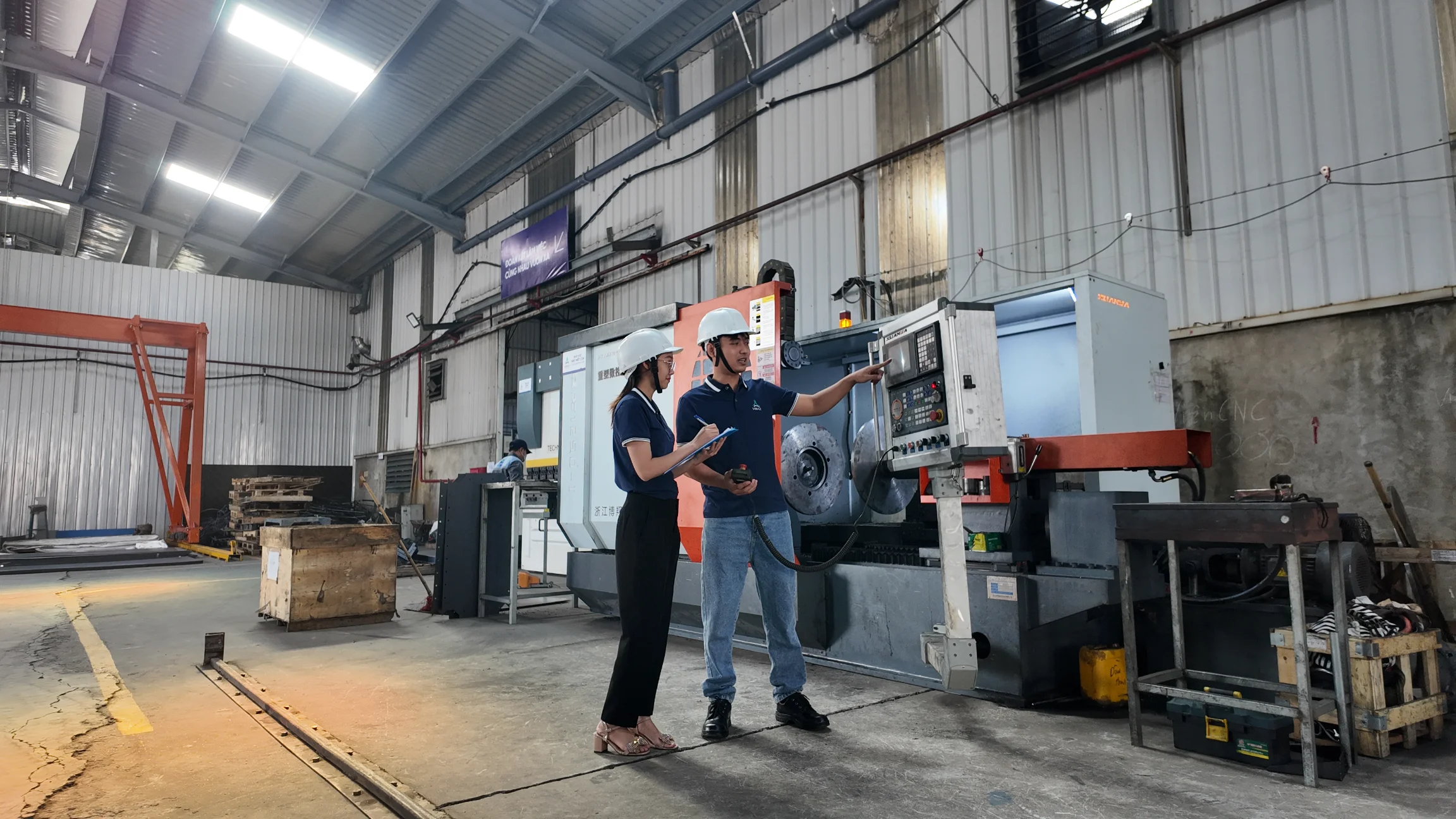
VIMAX Global is a Vietnamese manufacturer, not a US one, but it is a realistic option for buyers who want a second quote, are supplying projects outside North America, or need a customized solution in a shorter conversation loop with the factory. From factories in the Hanoi area and Phu Tho Province, VIMAX builds:
- Centrifugal fans: low, medium and high pressure, plus dust extractor fans.
- Axial fans: aluminum alloy blade, ducted, jet fans, roof mounted, round and square.
- Smoke exhaust fans: roof exhaust, axial and centrifugal smoke exhaust fans and wall-mounted types.
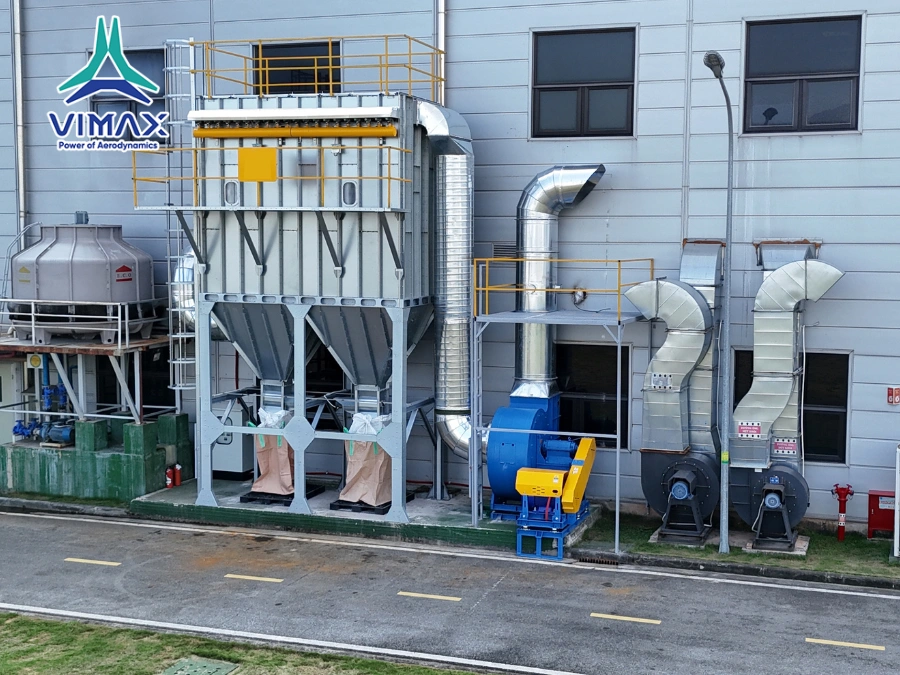
- Systems: dust collection, air filtration and cooling ventilation.
When you evaluate any overseas supplier, including VIMAX, ask for the same evidence you would demand from a US vendor: fan curves with test method, material certificates, balancing and vibration reports, motor and bearing brands, applicable certifications for your destination market, warranty terms and spare-parts commitments. You can contact VIMAX with your duty point and operating conditions to request a proposal.
Fan and Blower Types at a Glance
| Type | How it works | Typical applications |
| Centrifugal, backward-inclined or airfoil | Air leaves the wheel radially; high efficiency and non-overloading power curve | Dust collection, process exhaust, HVAC, boilers |
| Centrifugal, forward-curved | Many small blades; high flow at low pressure and speed | Packaged HVAC, light-duty ventilation |
| Centrifugal, radial / paddle | Rugged, handles dust and particulates | Material handling, dirty gas streams |
| Axial, tube and vane | Air moves parallel to the shaft; high flow, lower pressure | Tunnel and mine ventilation, cooling, process ventilation |
| Axial, propeller | Very high flow at very low pressure | Wall exhaust, cooling, agricultural ventilation |
| Mixed flow | Combines axial and radial airflow | Compact in-line exhaust, kitchen and laboratory exhaust |
| Pressure blowers | Higher pressure from compact housed wheels | Combustion air, pneumatic conveying, drying |
| Jet fans | Induce airflow without ductwork | Parking garages and tunnels |
| Smoke exhaust fans | Rated for high temperature for a stated time | Fire and emergency smoke extraction |
How to Specify a Fan: The Data Your Supplier Needs
Vendors cannot size a fan from “we need more airflow.” Prepare these inputs before you request quotes:
- Airflow (CFM or m³/h) at the real operating point, not only the nameplate maximum.
- System static pressure (in. wg or Pa), including duct losses, filters, dampers and any equipment downstream.
- Gas properties: temperature, humidity, altitude and density, because air density changes fan power and pressure.
- Contaminants: dust load, abrasive or sticky particles, corrosive gases, flammable vapors or explosive dust.
- Duty cycle: hours per year, start frequency, and whether flow must vary (a VFD changes both savings and motor selection).
- Construction: material (carbon steel, stainless steel, aluminum, FRP or coated), drive arrangement (direct or belt), and spark-resistant requirements.
- Environmental limits: sound level at the property line or in the work area, vibration limits and space constraints.
- Documentation: certified fan curves, material certificates, drawings, balancing reports and compliance documents for your site or market.
A quick power estimate helps sanity-check any proposal:
Fan input power (hp) = airflow (cfm) × pressure (in. wg) ÷ (6,356 × total efficiency)
Standards and Certifications to Look For
- AMCA 210 / ISO 5801: laboratory methods for testing airflow, pressure, power and efficiency. Ratings should come from a standard test, not only from calculations.
- AMCA 211 and 311 (Certified Ratings Program): AMCA-licensed air performance and sound ratings, shown by the AMCA seal.
- AMCA 300: sound testing of fans in a reverberant room.
- AMCA 204: balance quality and vibration levels for fans.
- AMCA 205 and 208: fan efficiency grades (FEG) and the Fan Energy Index (FEI) calculation.
- AMCA 99 spark-resistant construction (Types A, B and C): important when handling flammable gases or combustible dust.
- AMCA 801: specification guidelines for industrial process and power generation fans.
- UL 705 and NFPA 92: safety listings for power ventilators and requirements for smoke control systems.
- ISO 9001: quality management system, a baseline signal about manufacturing discipline.
- ATEX or IECEx: relevant when equipment will be installed in explosive atmospheres outside North America.
Not every standard applies to every fan. A good supplier will tell you which ones apply to your service rather than listing every acronym.
Efficiency Regulation: What Changed and What Is Coming
- DOE test procedure: on May 1, 2023, the US Department of Energy published a final rule establishing a test procedure for commercial and industrial fans and blowers based on the Fan Energy Index. Representations of fan efficiency were required to follow it from October 30, 2023.
- DOE energy conservation standards: in January 2024, DOE proposed minimum efficiency standards for general fans and blowers and for air circulating fans. At the time of writing, industry sources still described a final rule as pending, with compliance expected to begin several years after any final rule. Check the Federal Register and AMCA for the latest status before you rely on a date.
- Building codes: ASHRAE 90.1 and the IECC already use FEI for many HVAC fans, with a typical requirement of FEI at or above 1.00 for fans over a threshold power. Many US states have aligned commercial codes with these provisions.
- Exports and imports: EU Regulation 2024/1834 on fan efficiency began applying to standalone fans from July 24, 2026, so projects shipping to Europe should be reviewed against it.
The practical takeaway: specify FEI and fan efficiency data in your RFQ now, even for non-regulated applications. It makes bids comparable and prepares you for the standards ahead.
Market Snapshot
According to Global Market Insights, the North American industrial fans and blowers market was worth about USD 3.4 billion in 2025 and is forecast to reach about USD 5 billion by 2035 (roughly 4% annual growth), with the US the largest national market at about USD 2.9 billion in 2025. The same firm sizes the global market at around USD 10 billion in 2025. Different research houses use different definitions, so treat these as order-of-magnitude indicators rather than precise figures.
Commonly cited growth drivers include:
- Energy codes and efficiency programs pushing the market from fixed-speed systems toward variable-speed and EC motor solutions.
- Power generation and heavy industry needs, including retrofit and aftermarket work.
- Data centers and thermal management, which increase demand for cooling airflow.
- Air-quality and safety regulation, including dust collection and smoke control.
- Consolidation, as shown by SPX’s 2021 purchase of Cincinnati Fan and Baker Hughes’ 2026 acquisition of Chart Industries, which includes Howden.
Total Cost of Ownership: Why Price Is Only the Starting Point
For a fan that runs most of the year, the electricity bill typically outweighs the purchase price. Consider an illustrative duty of 20,000 cfm at 6 in. wg running 8,000 hours a year:
| Total efficiency | Input power | Annual energy | Annual cost at $0.10/kWh |
| 70% | about 20.1 kW | about 161,000 kWh | about $16,100 |
| 75% | about 18.8 kW | about 150,000 kWh | about $15,000 |
That five-point efficiency gain saves roughly $1,000 a year on one fan, and the saving repeats for the life of the equipment. Add the cost of downtime, bearing and belt replacement, balancing, and the availability of spare parts, and a slightly more expensive fan often wins. Variable-frequency drives can cut energy further wherever airflow demand varies.
Buying Domestically vs. Sourcing Overseas
| Factor | US-based manufacturer | Overseas manufacturer |
| Lead time | Short for stock or build-to-order models; long for large engineered fans | Includes ocean freight and customs; plan ahead |
| Support | Local representatives and field service | Remote support; confirm local partners or installers |
| Documentation | Widely recognized in US specifications | Confirm acceptance by your engineer, AHJ and insurer |
| Price | Often higher; includes domestic service network | Often lower on equipment; add freight, duties and tariffs |
| Customization | Strong at established firms | Often flexible on custom builds and quantities |
Tariffs and trade rules change frequently, so check current duties and the landed cost, not just the factory price.
Maintenance and Lifecycle Tips
- Plan for spares at purchase: bearings, belts, sheaves, shaft seals and an impeller for critical fans.
- Monitor condition: vibration, bearing temperature and motor current trends catch problems early.
- Keep the wheel clean and balanced: dust build-up is a leading cause of vibration and premature wear.
- Document the system: record as-built fan curves and field measurements to troubleshoot future issues.
For a deeper look, see VIMAX’s guides on industrial fan operation and maintenance and types of smoke exhaust fans and their applications.
Choosing Your Shortlist: A Quick Decision Guide
- Heavy process, power or mining duty: start with Howden, New York Blower, Chicago Blower and Twin City Fan Companies.
- Mixed commercial and industrial ventilation across many buildings: Greenheck, Loren Cook and Twin City Fan Companies.
- OEM integration or fast-turn custom blowers: Cincinnati Fan, Chicago Blower and Acme.
- Agricultural, horticultural or greenhouse ventilation: Acme and Twin City Fan Companies.
- Export projects or a second competitive bid: add a qualified overseas manufacturer such as VIMAX to the comparison.
Frequently Asked Questions
What is the difference between an industrial fan and a blower?
Both move air or gas, but they work at different pressure levels. By one common convention (ASME PTC 11), fans operate up to a pressure ratio of about 1.11, blowers between about 1.11 and 1.20, and compressors above that. In everyday use, “blower” often just means a higher-pressure centrifugal unit.
Should I choose a centrifugal or an axial fan?
Centrifugal fans are generally preferred when the system has significant resistance (ductwork, filters, dust collectors). Axial fans suit high flow at low pressure, such as wall exhaust, cooling and tunnel ventilation. Mixed-flow fans fill the gap when space is limited.
Direct drive or belt drive?
Direct drive has fewer parts and less maintenance, but speed is fixed unless you use a VFD. Belt drive lets you change speed by changing sheaves and keeps the motor out of hot or contaminated airstreams, at the cost of belt maintenance.
What is the Fan Energy Index (FEI)?
FEI compares a fan’s electrical power at a given duty point to that of a reference fan. A value of 1.00 means the fan matches the reference; higher is better. It is used in building codes and in the DOE test procedure for commercial and industrial fans.
When do I need a spark-resistant fan?
When the airstream may contain flammable gases, vapors or combustible dust. AMCA 99 defines Types A, B and C construction, which limit the chance that rotating parts create sparks. Your safety engineer or insurer should define the required type.
Can fans and blowers be custom-made for my facility?
Yes. Most manufacturers in this guide, and many overseas suppliers, offer custom materials, coatings, arrangements and accessories. Provide complete duty data to avoid redesigns.
How long do lead times take?
It depends on size and complexity. Stock or build-to-order standard models can ship in days to a few weeks; large engineered fans, special alloys and custom drives can take months. Ask for a written delivery schedule.
Do manufacturers provide installation, commissioning and maintenance?
Many offer startup supervision, field service, rebuilds and retrofits directly or through authorized partners. Confirm what is included in the quote and where service technicians are based.
How do I get an accurate price quote?
Send the data listed in the specification section above: airflow, static pressure, temperature, gas composition and contaminants, altitude, duty cycle, construction requirements and any code or certification needs. Quotes based on complete data are faster and far less likely to change later.
Final Thoughts
There is no single best fan manufacturer, only the best match for your duty, schedule and support needs. Use the profiles above to build a shortlist of three to four suppliers, send each the same complete data sheet, and compare bids on performance data, efficiency, lifecycle cost and service, not only price.
If you want an additional option for an export project or a custom application, VIMAX can review your requirements and propose centrifugal, axial, smoke exhaust or complete ventilation, dust collection and filtration solutions. Contact the VIMAX team with your duty point to get started.