


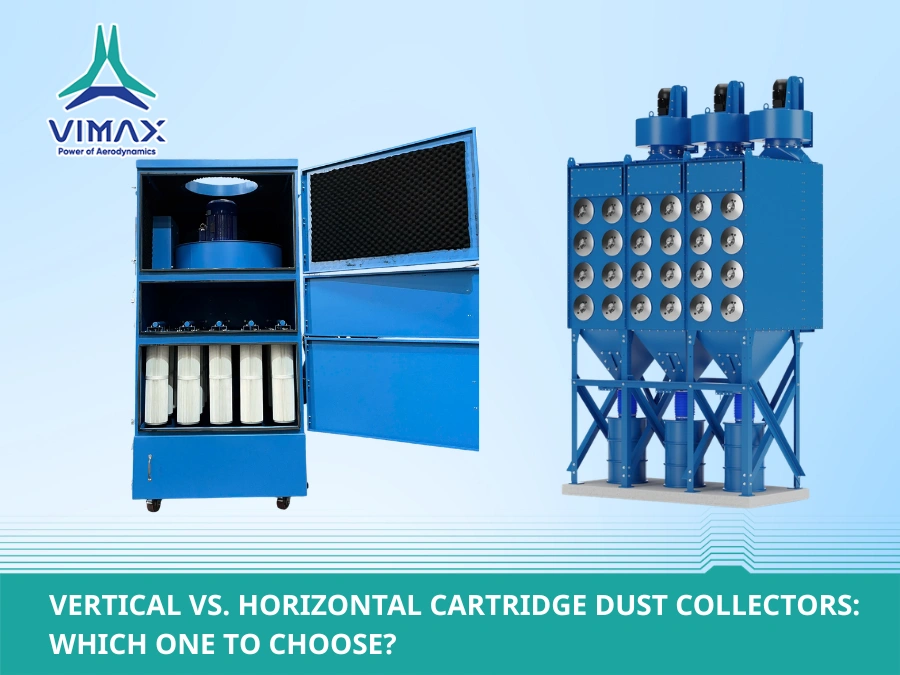
When designing and upgrading air pollution control solutions for factories, cartridge filtration technology is always a top priority for capturing fine and ultra-fine dust (such as welding fumes, laser/plasma cutting dust, dry pharmaceutical powder, powder coating, etc.). However, plant owners and operational engineers often face a critical structural dilemma: Should they choose a vertical (square-body) cartridge dust collector or a horizontal cartridge collector?
Choosing the wrong collector design not only leads to wasted factory space (e.g., overhead beam obstruction, blocking walkways) but also reduces automatic pulse-jet cleaning efficiency, increasing clogging frequency and cartridge replacement costs. This article from Vimax Global’s engineering team provides an in-depth analysis of pros, cons, aerodynamics, and a practical comparison table to help businesses select the most optimal equipment.
Overview of the Two Cartridge Dust Collector Designs
What is a Vertical (Square-Body) Cartridge Dust Collector?
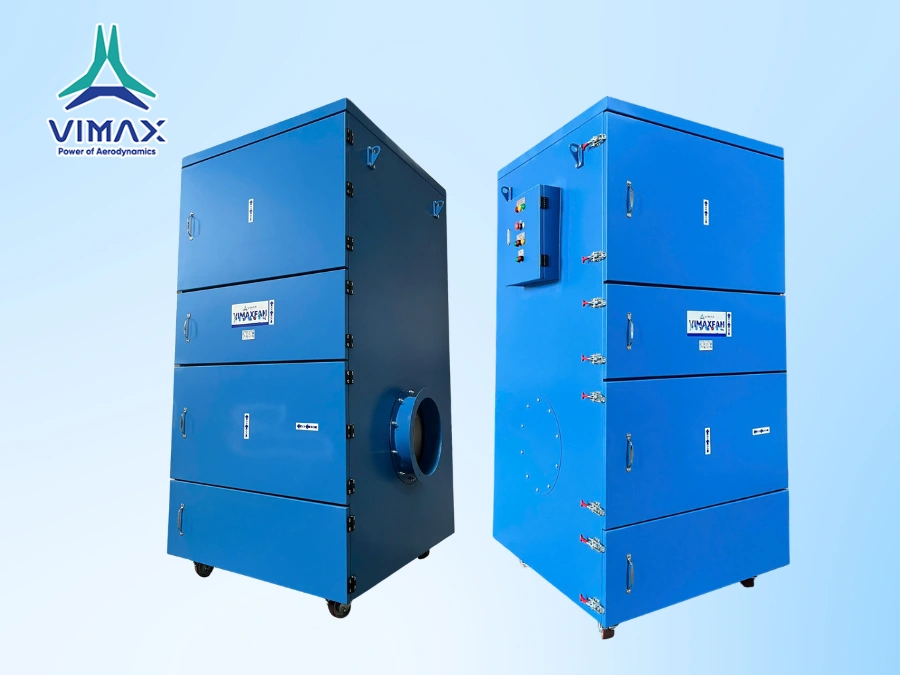
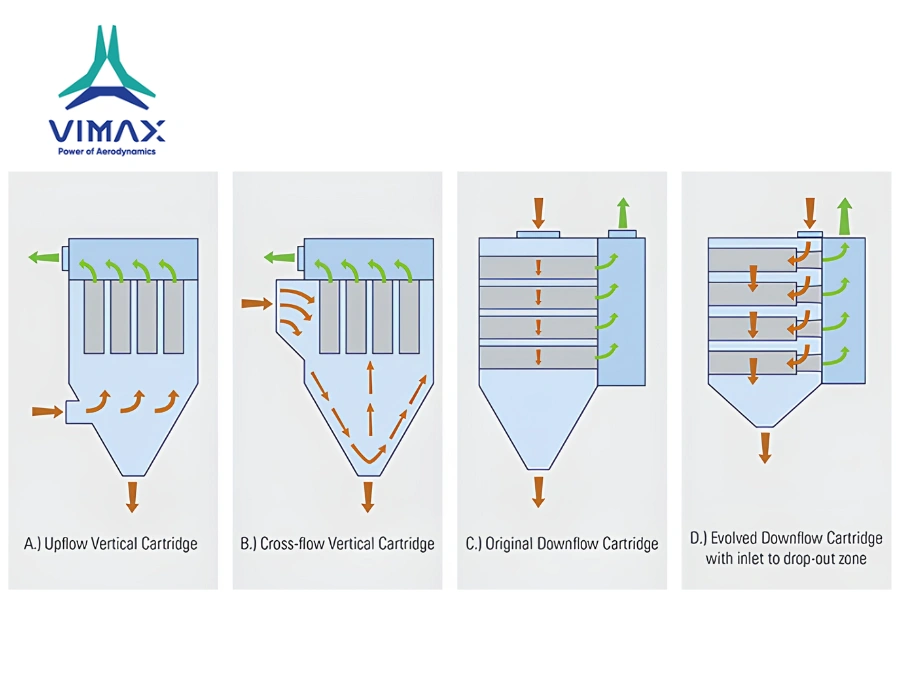
A vertical cartridge dust collector is a standard design where cartridge filter elements are arranged vertically inside the filtration chamber. Dust-laden air flows from the outside to the inside of the cartridge media. During the pulse-jet cleaning cycle, a burst of compressed air is directed from top to bottom. Because the pulse air direction aligns with gravity, re-entrained dust particles easily drop straight down into the hopper below without obstruction.
What is a Horizontal Cartridge Dust Collector?
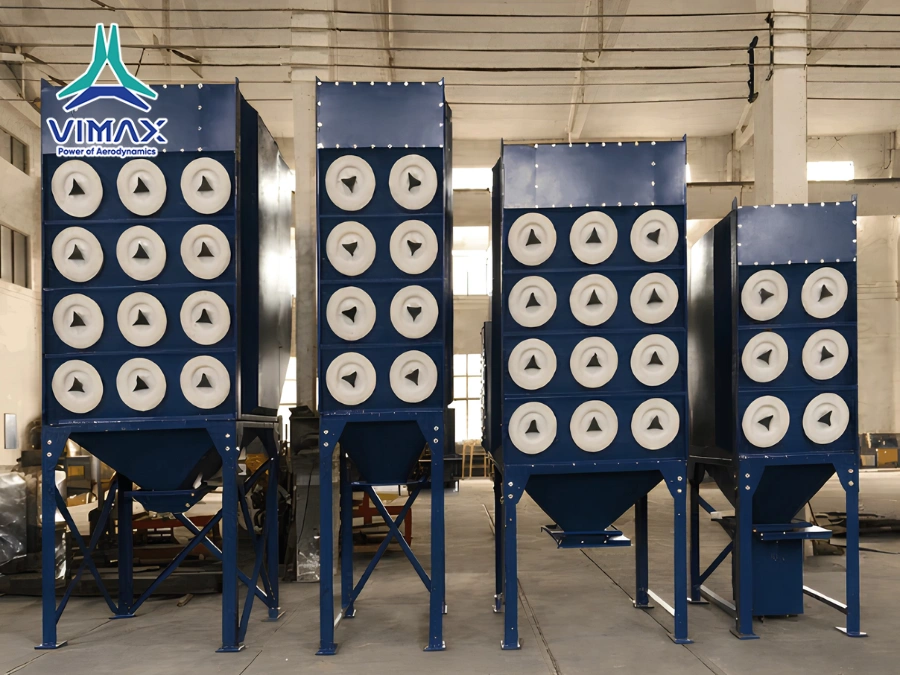
A horizontal cartridge dust collector features filter cartridges mounted horizontally in stacked tiers. This design minimizes overall unit height, allowing easy installation in factory spaces with low ceiling clearance. The compressed air pulse blows horizontally from the filter head to dislodge the accumulated dust layer from the membrane surface.
Detailed Comparison: Vertical Cartridge Collector vs. Horizontal Cartridge Collector
| Comparison Criteria | Vertical Cartridge Collector (Square-Body) | Horizontal Cartridge Collector & System |
| Cartridge Arrangement | Mounted vertically inside the collector body. | Mounted horizontally in stacked tiers. |
| Airflow Mechanism | Negative pressure; clean air flows from outside into the core then exits through the fan. | Dust-laden air passes through horizontal media; pulse jets discharge horizontally. |
| Expandability & Capacity | Standard single-unit / fixed square-body structure. | Detachable modular design, easily expands filtration area, supporting capacities up to 90kW. |
| Pulse Cleaning Efficiency | Very High. Dust drops straight down into the hopper driven by gravity without re-depositing. | Slightly Lower. Dust dislodged from upper tiers tends to fall and re-adhere to cartridges below. |
| Equipment Dimensions | More compact than baghouses for the same airflow, but requires vertical clearance. | Low profile, compact design; expands horizontally via modular connection. |
| Replacement & Maintenance | Easy access to replace cartridges from the front or side doors. | Extremely easy disassembly; quick cartridge swap-outs via side access doors. |
| Recommended Applications | Welding fumes, laser/plasma cutting, metal grinding, polishing. | Ultra-fine, dry, lightweight dust. Modular systems suit facilities with multiple suction points and high dust volume. |
Same topic: 6 Questions Businesses Must Prepare Before Requesting a Dust & Air Filtration System Quotation
In-Depth Pros and Cons Analysis
1. Vertical Cartridge Dust Collector (Square-Body)
- Pros:
- Very High Filtration Efficiency: Achieves 99.5 efficiency for fine particles down to sub-micron sizes (< 1μm).
- Optimized Design: Significantly more compact footprint compared to baghouse systems handling identical air volume.
- Efficient & Economical Cleaning: Downward pulse-jet cleaning combined with natural gravity removes dust thoroughly while minimizing compressed air consumption.
- Convenient Maintenance: Quick and easy filter replacement accessed from front or side doors.
- Cons:
- Higher replacement cost for cartridge filter elements compared to traditional filter bags.
- Requires adequate vertical ceiling clearance for installation and maintenance.
- Not suitable for specific dust types:
- High moisture or sticky/tacky dust (causes clogging in pleat valleys).
- Long fibrous dust (tends to interlock and tangle in pleats).
- High-temperature dust (unless pre-treated through a cooling phase).
- Ideal Applications: Perfect for dust generated from welding, laser/plasma cutting, metal grinding, and surface polishing.
2. Horizontal Cartridge Dust Collector
- Optimized Height Profile: Flat, horizontal design solves layout challenges in height-restricted factory space.
- Flexible Modular Structure: Multiple detachable module units can be linked together to expand filtration surface area, reaching high power capacities up to 90kW.
- Large-Scale Capability: Ideal for central filtration systems collecting large volumes of dust from multiple machinery workstations.
- Rapid Maintenance: Operators can quickly pull and replace filter cartridges via convenient side access doors.
- Cons:
- Prone to dust re-entrainment: Dust dislodged from top cartridges frequently falls and re-adheres to lower filter cartridges.
- Unsuitable for sticky, moist, hygroscopic, or excessively heavy particulate dusts.
Read more: Comparing Bag Filters and Cartridge Filters: 11 Key Criteria for the Right Choice
Expert Recommendations from Vimax: Which One Should Your Factory Choose?
- Choose a Vertical (Square-Body) Cartridge Collector when:
- Your facility performs continuous metal fabrication, grinding, polishing, laser/plasma cutting generating large amounts of fine, dry metal dust.
- You require a solution more compact than a baghouse while maintaining superior filtration efficiency (99.5) and air-saving pulse cleaning.
- Your factory layout has comfortable ceiling height and you want straightforward maintenance access from side or front doors.
- Choose a Horizontal Cartridge Collector / System when:
- Factory layout is strictly constrained by low ceiling heights or overhead structures.
- Generated dust is ultra-fine and ultra-lightweight (e.g., powder coating recovery, dry pharmaceutical powders, electronic component dust).
- Large-scale operations with multiple suction points: Opt for a Modular Horizontal Cartridge Dust Collection System (up to 90kW capacity) to handle high airflow demands, save vertical overhead space, and simplify future filtration capacity expansion.
Both vertical square-body cartridge collectors and horizontal cartridge systems (including single units and high-capacity modular configurations) offer unique advantages regarding aerodynamics, capacity scaling, and space optimization. The right choice depends directly on your dust loading, particle characteristics (moisture/stickiness/fibers/temperature), total suction points, and factory space constraints.
CONSULT & DESIGN DUST COLLECTION SYSTEMS WITH VIMAX GLOBAL
Still unsure which collector structure will deliver the highest technical and economic efficiency for your plant? Contact Vimax Global today – a leading engineer and manufacturer of industrial fans and dust collection systems in Vietnam. Our engineering team is ready to conduct on-site surveys, provide free 3D layout designs, and deliver competitive quotes!
