


When in need of installing an industrial dust collection or air emission treatment system, many businesses often contact manufacturers with a generic request: “Give me a quote for a woodwork factory dust collection system” or “Quote me a cement air treatment system.”
As a result of this lack of information, both parties waste significant time revising designs, technical feedback is delayed due to insufficient data, or worse, businesses receive an inaccurate quotation that does not align with their actual needs and budget.
With experience in implementing hundreds of real-world projects, Vimax Global has compiled the following 6 key pieces of information to help businesses proactively clarify issues, thereby maximizing survey time savings and optimizing investment budgets. Check it out now!
Why Should Businesses Prepare Information Before Requesting a Quote?
Preparing basic information thoroughly before contacting a manufacturer is not only a stepping stone toward a more professional workflow but also brings 3 core benefits:
- Avoid Technical Risks: Understanding your needs clearly helps design engineers create precise configurations from the very beginning. This minimizes situations where delivered equipment does not match the intended purpose, directly affecting payment schedules and incurring extra costs for compensation or repairs.
- Save Time and Costs: Reduce the number of unnecessary field survey visits. Suppliers can leverage available data to optimize designs remotely, accelerating the quoting progress.
- Comply with Environmental Laws: Ensure that the emission system, once completed, fully meets current environmental discharge standards based on the specific legal profile of each factory.
6 “Golden” Questions to Answer Before Requesting a Quote
1. Where is the factory located, and what industry is it operating in?
- Purpose: Identifying the geographical location helps the supplier accurately calculate transportation, logistics, and installation labor costs, while also understanding the specific characteristics of the emission source.
- Information to provide: Does your factory belong to a heavy industry (cement, metallurgy, raw wood processing, chemical production…) or a light/fine industry (pharmaceuticals, electronic components, powder coating, food…)? The physical nature of the dust particles (coarse, fine, moist, sticky) and the properties of the gas stream will directly determine the choice of a suitable filtration technology, such as baghouses, cartridges, or cyclones.
Read more: Optimal Fine Dust & Paint Odor Control Solutions for Powder Coating and Woodworking Workshops
2. Has the factory obtained an Environmental Impact Assessment (EIA/DTM) report?
- Purpose: Closely align with legal regulations and current discharge standards of specific regions or industrial zones.
- Details to clarify: How strict are the requirements for the output air quality after filtration? For instance, does the air stream only need to meet standards for regular ultra-fine dust, or must it completely eliminate “blue/white smoke”, odors, and hazardous environmental pollutants? This determines whether the system will utilize mechanical filtration methods or must integrate additional chemical or biological modules.
3. Do you have actual photos/videos of the area where dust or emissions are generated?
- Purpose: Help the supplier easily visualize the space, installation layout, and any potential obstacles at the workshop.
- How to prepare: Take short videos or detailed photos of the pollution sources at the factory (machinery processing areas, welding smoke locations, incinerators…). Visual materials help engineers decide whether an immediate on-site survey is mandatory, thereby saving time and costs for both sides while ensuring the most accurate preliminary quotation.
Read more: Top Fans for Large Industrial Spaces: The Ultimate Cooling & Ventilation Guide
4. What are the specific locations that need dust or gas extraction? What are the dimensions and number of suction points?
- Purpose: Thoroughly collect dust and emissions right at the source, preventing pollutants from spreading freely into the factory workspace.
- Technical data needed: Clearly identify the quantity and dimensions of the suction hoods/mouths that need collection and treatment. Calculating the total number of suction points is the core basis for engineers to calculate the total required airflow (m^3/h) and select the appropriate centrifugal fan capacity (medium or high pressure).
5. Does the factory have a system design drawing or a workshop layout drawing?
- Purpose: Avoid wasting time measuring from scratch and minimize spatial discrepancies.
- Benefits: If the business already has a machinery layout drawing or an old design profile, engineers can instantly draft the most optimal ductwork path. This helps reduce pressure loss (Pa) throughout the system. Especially for limited spaces (low ceilings, narrow areas), the drawings will help determine the most suitable configuration and form factor of the dust/air treatment system.
Read more: Centrifugal Fan vs. Axial Fan: Choosing the Right Industrial Solution
6. What are the physicochemical properties of the dust or hazardous gases that need treatment?
- Purpose: This is an in-depth technical question that determines the durability of the system. Based on these characteristics, engineers will select the most suitable filtration materials (filter media, carbon types, packing media…) and filter cleaning mechanisms to ensure the system operates reliably without clogging or corrosion.
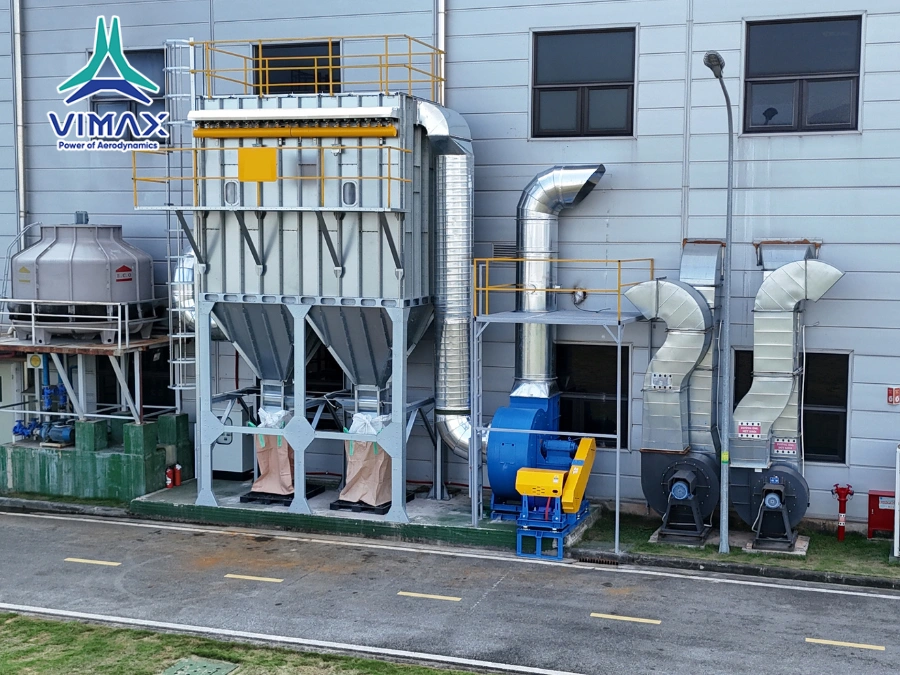
Businesses can refer to the following technology matrix based on emission characteristics (applicable to both dust and air filtration systems):
| Emission Characteristics | Preferred Technology |
| Dry dust, large particles | Cyclone |
| Dry dust, fine particles | Baghouse Dust Collector |
| Ultra-fine dust | Cartridge Dust Collector or Wet Electrostatic Precipitator (WESP) |
| Moist, sticky dust | Wet Scrubber |
| White smoke, acid mist | Wet Electrostatic Precipitator (WESP) |
| Acidic hazardous gases (HCl, HF, $SO_2$, etc.) | Absorption Tower using alkaline solutions (Scrubber) |
| Alkaline hazardous gases ($NH_3$, etc.) | Absorption Tower using acid solutions |
| Volatile Organic Compounds (VOCs), solvents | Activated Carbon Adsorption or RTO/RCO thermal oxidizers |
| Odors (livestock, waste treatment, chemicals) | Biofilter, UV, Ozone, or Activated Carbon systems |
| Oil smoke, oil mist (machining, food processing) | Electrostatic Precipitator (ESP) or WESP |
Optimal Quotation Coordination Process at Vimax
To simplify the workflow and provide the fastest service experience, Vimax applies a standardized 4-step coordination process:
- Step 1: Information Reception: The customer contacts Vimax and provides answers based on the 6 core questions mentioned above.
- Step 2: Analysis & Remote Consultation: Vimax’s experienced engineering team studies the photos, drawings, and emission characteristics to propose a preliminary treatment solution.
- Step 3: Detailed Survey (If necessary): Vimax technicians conduct actual measurements at the workshop to finalize the construction plan and the most optimal equipment layout.
- Step 4: Design & Optimal Quoting: Vimax issues precise production orders, committing to offering a quotation that closely matches actual usage needs while minimizing investment costs for the business.
Preparing detailed information thoroughly before requesting a quote for a dust and air filtration system not only demonstrates a business’s professionalism but is also the golden key to owning a system that runs stably, saves energy, and fully complies with environmental standards.
At Vimax Global, we understand that there is no single universal dust filtration or exhaust gas treatment system for every factory. Each specific emission source and factory space requires a specialized design solution to achieve maximum filtration efficiency and durability. Providing this basic information beforehand will help Vimax engineers quickly develop the most accurate technology plan for your business. Let Vimax Global accompany you on your journey to creating a green, safe, and sustainable production environment. Contact our Technical Department today for consultation and the best possible quote!
